Sunday, May 1, 2016

An update to an update: Visual literacy: An update

Look at that headline above… just look at it! 

I am still adjusting to the fact that not every word in a header should be capitalized! In the land of my comfort zone, this is what I want to see: 

Yet, I’ll admit, the more I look at the correct headline the more comfortable with it I become.

I’ve had some light-bulb moments during this course. It started with the use of at least 1” margins in my WET layout.

I have always disliked wide margins because I feel like they are a waste of space, and also contribute to a considerable waste of paper. But in keeping with the guidelines of a WET layout as defined in WSINYE, I followed suit and allowed for "generous margins on all four sides." In the end I was quite satisfied with the final result. I even chose to use 1.5” margins, omitting the pink border, when all was said and done. 

Speaking of the pink border, using the element of repetition, as discussed in Dawn's Poster Pointers PowerPoint (side note: gotta love the alliteration), the shade of pink that I used for the headline and border was pulled directly from the pink of the bottom tier of the cake in the visual. Additionally, I used contrast in the copy and tags by choosing a vibrant blue color just a few shades darker than the blue used to border every tier of the cake.


The moment that stands out to me the most so far, is learning that “rivers of white space” can be eliminated by taking out the double space after a period. I write a lot at work. Tons, and tons, and tons of emails every day, so I’ve had a good amount of practice this week eliminating the double space. I don’t always catch myself, but at the very least I will do a “replace all” at the end of my document to find all my goofs. I’m happy to say the number gets smaller every time.

My heart does ache about this recent realization, though, and here’s why. Recently I put weeks of work into re-vamping the Moodle site we use at work. I am proud of all the hard work that has gone into it, but now when I look at a page, all I see is the insane amount of errors! Just look at all those double spaces! (Highlighted in yellow.) There are 14 more pages like this, with just as many errors on each page. Guess who's spending a good chunk of time this week making some serious corrections?


I went to the Milwaukee Art Museum on Saturday April 30th, and purposely spent more time in front of the pieces than I had before reading The Art of Slowing Down. My date thought this was cute at first. After a while he was all, "I'm hungry. My feet hurt. I get it, you like art." 

One particular painting really caught my eye, Xmas in Gilroy by Robert Alan Bechtle. 


What really sucked me into this piece was that most of the painting is sharp, almost hyper focused. My eyes would not budge off of the front edge of the coffee table. Yet the female subjects in the painting are fuzzy and blurry. My first thought was, "Does this fit into the category of photo-realism or not?" I stood there for several minutes wondering why Bechtle chose to paint the women out of focus. (I think my date circled the gallery four or five times before gently pulling me away from the painting.) Was he trying to evoke movement? Was he implying that this was to look like a time-lapse photo and they had been sitting there talking for several hours, barely moving an inch? Was it that his parents’ or grandmother’s living room was so clearly etched into his memory, but the people were hazy? 

We only made it through a portion of the museum, so I’m really looking forward to going back soon (maybe next time without a date) to really sit and ponder more works. I'm certain I'll get stuck in front of Xmas in Gilroy again.

I came into this class with an open mind, but I will admit I had a bit of a chip on my shoulder because I use visual communication constantly at work. I knew I would learn, but, In all honesty, I did not expect that I would come away with so many mind-blowing discoveries. I have already started incorporating what we've learned into my daily work, and I'm excited to see how my personal style will further change as I settle into a greater awareness of my own visual literacy. This course has been a sampling menu of the exciting world of visual communication and I am hungry for more.

What were your preconceived notions of this course? Have you had any mind-blowing moments? 

Sunday, April 24, 2016

Color

Color is a very important part of my life. I might dress in mostly black and carry a grey purse, but I need to be surrounded by color in order to feel “just right.”

I enjoyed listening to Angelica Vazquez in class this past week. A good part of what she does is to make sure color comes out “just right” in the print jobs put out by her company.  

I found it particularly interesting when Angela said that sometimes tweaking a print to be “just right” could mean adjusting the CMYK setting only by 1% of one of the four colors:
Cerulean, Magenta, Yellow, and black or Key (p. 128 WSINYE). 


My ColorSurvey results were as follows:


Compared to the global results:


My color preferences aligned with a good portion of the global results. Even if the colors weren’t exactly the same for some (good tasting, sexiness, mourning, and nausea), they were in the same color family. It would be interesting to see on a map where the test results have come from. My guess is that the bulk of the surveyed come from Western cultures, based on some of what we discussed in class.

I quite enjoyed seeking out pictures to go along with my color preferences from the survey. As stated on page 114 of WSINYE, “color evokes emotion,” and I was definitely inspired while searching for some examples. 


When I think of “good tasting” or “delicious” I see this color:
 
It reminds me of summer berries, and rich, supple red wine. 


A fruit I have always been very intrigued by, but haven’t yet come into personal contact with, is the beautiful red/purple/pink, dragonfruit.  This vibrant fruit’s color has a lighter tint than the deeper burgundy shown above, but it stays in the family as a cooler reddish purple, with a bluer tone.


Curious what this strange little fruit looks like on the inside?


I enjoyed this next picture because it references a specific Pantone color, which stood out to me from our class discussion with Angela.

From here I was reminded of one of my very favorite pastry kitchen staples, raspberry coulis (pronounced COO-LEE). 


When raspberries have been freshly pureed, they have a beautiful deep, red-purple hue that just screams out...


“EAT ME, I’M DELICIOUS!” 


Unfortunately, next we move on to a color that nauseates.


This color, reminiscent of stomach bile, really ups the "ick" factor.


For those of you who, like me, love horror movies, I’m guessing you may also think about the awful “pea soup” scene from The Exorcist when you see the sickly muted yellow-green.

To refresh your memory, or if you haven't seen the movie, I've found a more whimsical interpretation of that bilious moment.


Speaking of bile, the gallbladder is a verdent little organ that in the past has caused some very nauseating moments for me.  

We didn’t get along very well, so in 2006 she and I parted ways. Good riddance, I say.  


Considering wealth, this is the color that comes to mind:
 

This color evokes luxury and extravagance.


Recently I read an article about one of the newest sculptures to join the collection at the Guggenheim museum in New York City. 

Entitled, Maurizio Cattelan: America, this piece is a fully functional potty that will be placed in a publicly accessible single stall bathroom in the museum.  

Shy bladders beware, there will be a guard outside the bathroom at all times!
Reference, http://www.centredaily.com/news/nation-world/national/article73466132.html


In my searches I also stumbled upon quite a fascinating little beauty trend that has recently popped up among the wealth, golden facials. 

Considering the fact that gold is considered to be relatively inert, I can’t imagine that this procedure has any real benefit to the skin. 

But hey, it sure looks purdy!


And lastly, because everything comes back to pastry for me, I’ll close this week’s blog post with another mention of dessert.

Serendipity III in New York City has on its menu two rich, chocolate, decadent, and golden desserts.  

The Golden Opulence Sundae which will set the diner back a reasonable $1000.00


And it’s slightly pricier cousin, the Frrrozen Haute Chocolate, for a cool $25,000.00


Added 04/27/16
Had a little giggle last night when I found this on Pinterest:


Tuesday, April 19, 2016

Adding Visual Appeal

“It is really important to have everything properly arranged.” Says Lilian of DesignFloat.com.  Nothing could be truer than this when advertising something like furniture.  

I really had a good giggle out of that idea just now when I looked over at the new couch I recently purchased for myself on Wayfair.com.  I spent hours shopping for the perfect piece for my apartment.  This couch would be the first nice piece of furniture I was purchasing for myself, EVER, without having to compromise with a roommate or a stinky ex-boyfriend.  So I wanted to make sure I got THE couch. (As pictured on the right)


What first drew me to the couch was the fact that it was set in an environment with an aesthetic similar to how I decorate at home.  The color scheme and accessories are a bit different, but the look is simple and uncluttered, and I could “see” myself in that room relaxing on that couch.

The photo above follows several of the guidelines of a “well-composed photo” as outlined in our text, White Space is not Your Enemy:

  • The angle of the couch, along with the arrangement of the blanket and pillows, allows the photo to be asymmetrical.  Yet the identical end tables on either side of the couch add to the element of balance. 
  • The photo is not exceptionally tight with the cropping in terms of the couch itself.  Considering this could be a much larger room, the non-applicable areas are omitted which allows the consumer to really focus on the couch.  The low profile end tables also allow the couch to really remain the focal point of the shot.
  • I absolutely love the repetitive parallel lines in this shot.  The lines created by the angle of the couch are pulled into the structure in the walls and the window sill.  It really makes the couch look like it was “meant” for this room.  To me, the repetitive, parallel, slightly diagonal lines play up the relaxed and comfortable feel of the furniture as if to say, “It’s refined, but not uptight or sterile.”


My couch that is in my periphery as I type this blog, no longer looks anything like the couch above.  And for good reason.  If I logged onto Wayfair.com and saw the jumbled mess on the right, I would seriously question the company’s desire to sell any furniture at all. The angle of the couch in both pictures is similar, and there are certainly blankets and pillows “arranged” on my couch too, but which one would you choose to buy?


Footnote: Notice the upside-down umbrella poster on the right?  :)


Sunday, April 10, 2016

Animoto


I delayed making my Animoto for probably about as long as I could, because I just wasn't sure what story I should tell.  As with many things in my life, it all came back to cake.  I was worried at first that I wouldn't have enough material to choose from, but that quickly changed to having to edit out a big chunk of pictures to avoid being redundant.  Apparently cake really has taken up a big part of my life!

I sometimes feel saddened that I haven't take a more deliberate route with my cake career.  In the past, I was always too stubborn to work for someone else's cake business, and too scared to fully venture out on my own.  So, cake has always been more of an enthusiastic hobby than something I could make a living on.  What this project has taught me is that even though I've never really made any money on my cakes, I've touched the lives of many of my closest friends and family with something I am incredibly passionate about.

In a two minute video, it's hard to see that my cake journey has spanned 12 years of my life.  I have been able to be present at many birthdays, weddings, and personal milestones worthy of celebration.  Wherever I go it is always my intent to spread happiness and goodwill.  I have succeeded more than I often realize, by filling many tummies, familiar and not, with tangible and edible love.

My cakes may not have made me a household name, and they have certainly not increased the size of my bank account, but they have certainly made me happy.  At the end of the day, that's really what matters most.

After all, to quote the late, great, Julia Child...

Sunday, April 3, 2016

The Art of Slowing Down

I have been craving a visit to an art museum for some time now, but unfortunately my schedule hasn't allowed spare time for an afternoon of wandering.  So, I was thrilled when it was absolutely necessary for me to take a moment and pause to appreciate the Sacagawea Art Collection at Alverno.

I wanted to go with my gut when choosing the piece I would analyze, so I very quickly perused the collection.  I made an effort not to get particularly close to any piece, and viewed each piece for only about 10-15 seconds.  I did also try and keep in mind the idea of, "If I were the recipient of this award, which one would I be most excited to get?"

I enjoyed each piece, but at first nothing really jumped out at me.  I realized I had missed the section of the gallery by the elevators, and as soon as I got close enough I knew which piece was "mine."


The art book by JoAnna Poehlmann is unlike any of the other pieces in the collection.  It spoke to me first because I knew I would have to slow down considerably to read each page.  The script was in cursive, and since some pages were at quite an angle, I really had to crane my neck (and sometimes guess the words) to understand the passage.

What I appreciated most about this piece was that by creating the book, Poehlmann was, in a way, writing a journey log just for Sacagawea.  It is a small piece compared to what I assume are numerous volumes of journey logs created on the Lewis and Clark expedition, but I think that adds to its appeal.  I was excited to move from page to page, and it left me wanting to learn so much more about Sacagawea due to all that has been omitted from the history lessons we were taught in school.

The first of the seven elements of design, as mentioned in White Space is Not Your Enemy, is space.  “Space is a requirement.”(p. 45) This piece, when unfurled, takes up quite a bit of physical space, but in terms of composition, there is a vast amount of negative space.  Keeping each page to one specific entry, the artist allows the viewer focus solely on that event. The entry regarding fish has the least negative space of all, using a crowded page to evoke the feeling of a school of fish.  It also made me think of being in the bug exhibit at a natural history museum, where all the specimens are tightly organized into little drawers.

The element of movement was clearly evident throughout this piece, from the accordion style book fold, to the way the lines of script are arranged on each page, to the artist’s beautifully neat penmanship.  In order to read the entire book, I had to move several feet.  A minuscule distance compared to Sacagawea’s journey, but as I was reading I appreciated that as a viewer, I had to travel my own journey to reach the end of her story.

Sunday, March 20, 2016

Looking and Seeing


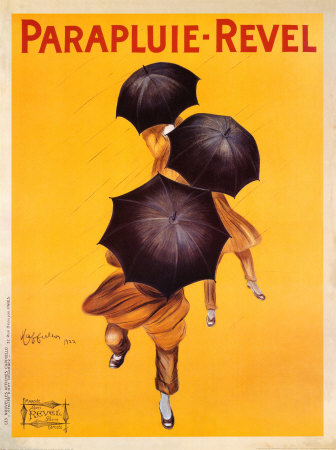
I have owned a reproduction of this umbrella poster for almost 10 years.  I have always enjoyed the look of old fashioned advertisements, and this one has followed me from home to home.  Even though my décor has changed many times over the past decade, this piece has remained part of my “permanent collection,” if you will.  I have studied this poster many times while eating dinner or zoning out while doing homework.  I have looked at it so many times that I could probably draw it from memory at this point.  
(But I can’t promise the drawing would be very good…)


In the text White Space is not Your Enemy, the author states, “Negative space always has weight and structure in graphic design.” I think this poster is an excellent example of that argument.  Part of what makes this poster so striking is the vast amounts of negative space being used.  There are other advertisements in this style, from roughly this same time period (as pictured below) that also rely on the abundant use of negative space to weigh their design.  There is very little to take away from the product being sold, and the bold use of colors allows both posters to draw the viewer in immediately.
                                               
These advertisements are also a good example of what Brian Kennedy refers to when he says that visual literacy is a universal language. The umbrella poster is written in French, but you don’t have to speak French to know that this poster is selling.  Same goes for the Italian poster for pasta.


The clean, simple, and impactful design of these two posters were evidently successful in making a lasting impression on consumers.  A simple Google search for “umbrella poster” or “spaghetti poster” will bring up myriads of hits for both of these works done by Leonetto Capiello.  Neither brand, Revel nor Baroni, is still in business today, but some 90 years later, their advertisements are still widely known.